Giant mushrooms looming all over the lands, elephant legs with eerie pink flowers growing on top sticking their stems out from rocks, sky-scraping ogres almost bald-headed with creepy hair standing tall in the forest - you would ask, is this a fantasy dream alive in the mind of Guillermo del Toro ?
But no, this is not a fantasy, let alone a dream. It's a real place on Earth, in the Indian Ocean off the coast of the Horn of Africa. It is a small archipelago of four islands and islets in the Indian Ocean, some 350km south of the Arabian peninsula, belonging to the Republic of Yemen. - Wikipedia: Socotra.

The main island of Socotra, spanning over 30 to 35km north to south and 130km east to west, is one of the most isolated landforms on Earth of continental origin. The archipelago was believed to have started its long detachment from main continents since the Miocene, some six or seven million years ago.
This harsh and dry land, which derives its name from Sanscrit word meaning "the island of bliss", is considered as the "jewel" of biodiversity in the Arabian Sea. And people name it that way for a good reason. - Dark Roasted Blend, Wikipedia: Socotra.
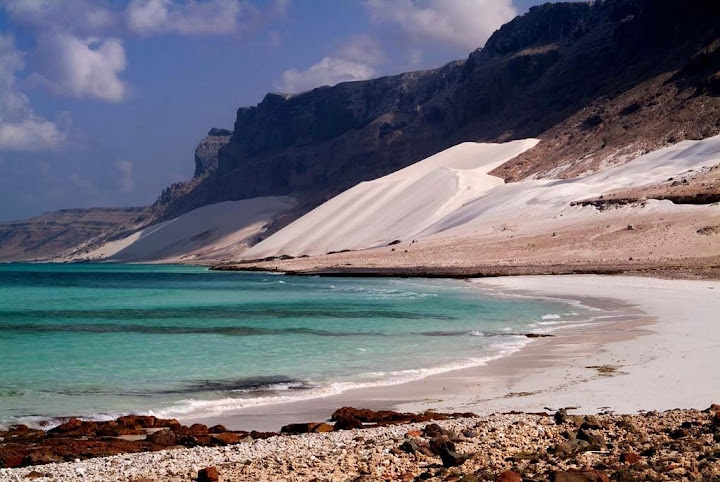
For millions of years the island has been isolated, providing a suitable environment to preserve a bizarre botanical paradise, since the time of Gondwana, the massive supercontinent once existed on Earth 180 to 200 millions years ago. The long geological isolation of the Socotra archipelago explains the teeming plants varieties on the island - with 700 extremely rare species of flora and fauna, more than a third of the 800 or so plant species are found no where else. Some varieties have even been preserved for 20 million years, i.e. haven't changed their forms or ways of living for those million of years!
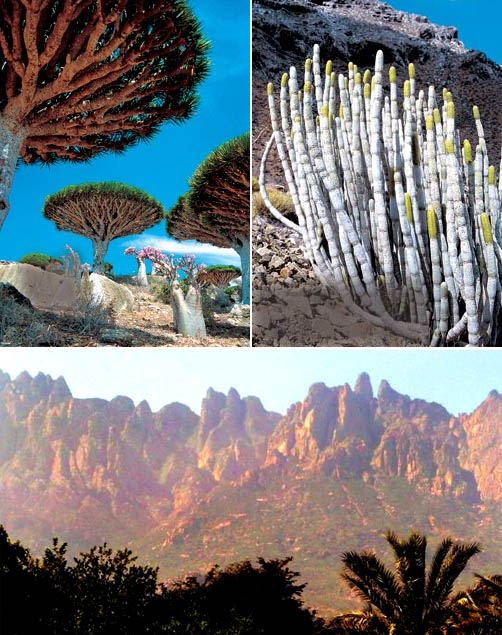
As we have a grip on what and how Socotra island is, we shall look back at our otherwordly landscape we just thought came out from Pan's Labyrinth nightmare.
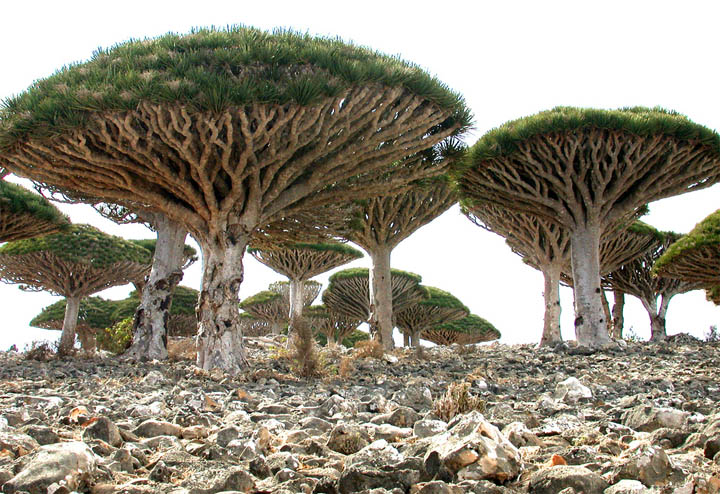
Looking closer, the giant mushrooms looming all over the lands are not mushrooms after all. They are trees, with such great name - the dragon's blood tree, or dracaena cinnabari. The tree has branches spring upwards forming an umbrella-shaped tree top, and when seen from afar, looks just like a giant mushroom. In spite of its uncanny appearance, its red sap was highly sought after as a medicine and a dye.
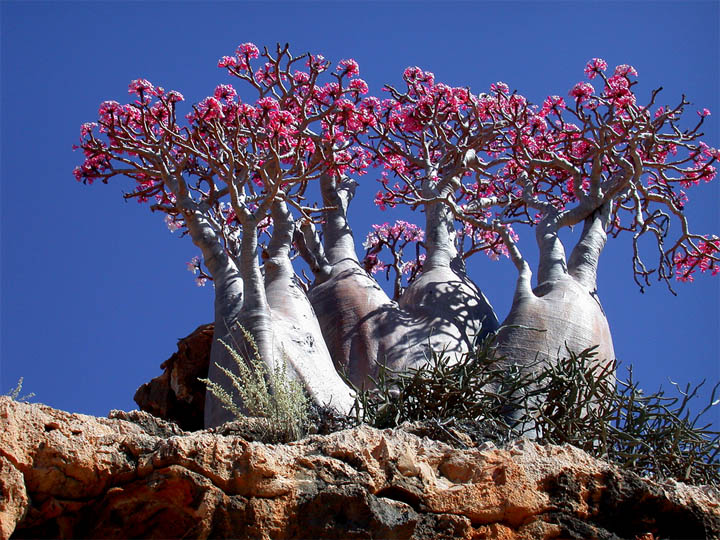
Next are the disputable elephant legs sticking out of rocks with odd flower branches, except that they are not elephant legs (obviously), but stems of another rare botanical species, the desert rose, or adenium obesium. Weirdly enough that these rather ugly-looking plants which reminded me of literal meanings of frump, are called as the delicate, fragile and graceful rose of the desert (I would say it doesn't live up to half of its name), they actually have more stoical bearing than roses. They grow their roots without soil and straight through the hard rocks.
Leave the harsh roses aside, and we shall look at the ogre with eerie hair like Medusa's. Of course it is not an ogre, instead it looks more like a papaya tree's stem, except that it is taller, more taller, and fatter. It's the cucumber tree, or dendrosicyos socotranum. It doesn't resemble any forms of cucumbers to me, but maybe those bare leaves dangling over its top like some monster's hair do dangle in a cucumber dangling style.

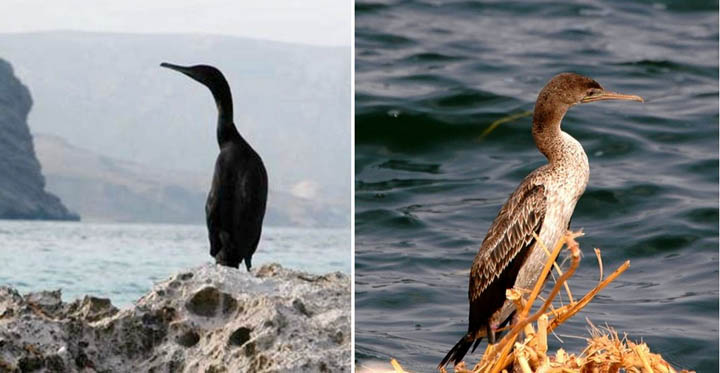
In addition to the botanical's version of Jurassic park on the island, it also has a fairly rich bird fauna, including a few types of endemic birds, such as the Socotra Starling Onychognathus frater, the Socotra Sunbird Nectarinia balfouri, Socotra Sparrow Passer insularis and Socotra Grosbeak Rhynchostruthus socotranus. - Wikipedia: Socotra.
Socotra was recognised as a world natural heritage site by the United Nations Educational, Scientific and Cultural Organisation (UNESCO) in July last year. The island has around 40,000 populations, but it has only has it first roads in 2006. It is geared towards sustainable eco-tourism and thus, it seems that you would have to get a camel to walk the lands. - Dark Roasted Blend.
If there is any places I would want to visit at least once in my life time, I would tick this island as one of them. It's great to be transported back in time to some ancient era in Earth history to have some otherworldly experience, except for the camel-riding part. But who knows, it might feel better than you thought!
Images and information sources: Dark Roasted Blend, Wikipedia: Socotra.


